Digital goods, from SaaS subscriptions and API access to game items, templates, premium content and software licenses, are one of the best use cases for crypto payments. The product is delivered instantly, the customer base is global, and many buyers already hold crypto. Yet most digital goods sellers still rely exclusively on card payments, dealing with chargebacks, regional payment failures, and processor restrictions.
Here's why crypto makes sense for digital goods and how the integration actually works.
The chargeback problem
Chargebacks are the biggest pain point for digital goods sellers. A customer buys a software license, downloads it, then disputes the charge with their bank. The bank sides with the cardholder by default. You lose the product, the revenue, and pay a dispute fee on top.
Chargeback rates for digital goods are significantly higher than for physical products because there's no shipping receipt to prove delivery. Some payment processors flag digital goods merchants as "high risk" and charge higher processing fees or refuse to onboard them entirely.
Blockchain payments eliminate this problem. Once a transaction confirms on-chain, it's final. There's no bank to call, no dispute process, no reversal. The customer sent the crypto, you received it, and the blockchain is the receipt.
Global reach without payment friction
Card payments fail for a surprising number of legitimate customers. International cards get declined. Some countries have limited card infrastructure. Currency conversion adds fees and confusion. 3D Secure adds friction that kills conversion rates.
Crypto payments sidestep all of this. A customer in Lagos, Berlin, or Jakarta sends USDT from their wallet to yours. The transfer costs the same regardless of geography, settles in the same timeframe, and doesn't require the customer to have a bank account or credit card.
For digital goods sellers with a global audience, which is most of them, this opens up revenue from customers who couldn't pay before.
Instant delivery, instant payment
Digital goods are delivered instantly. The payment should match. With card payments, "settlement" means your money arrives in your bank account 2–7 business days later. With a non-custodial crypto processor, the funds land in your wallet the moment the transaction confirms on-chain, typically in under a minute on BSC.
This is especially valuable for automated delivery flows. Your server receives a webhook confirming payment, grants access or delivers the license key, and the customer is using the product within seconds. No pending states, no "payment processing" delay screens.
How to integrate crypto payments for digital goods
The integration follows the same pattern as any payment API. Here's the flow with PayHook:
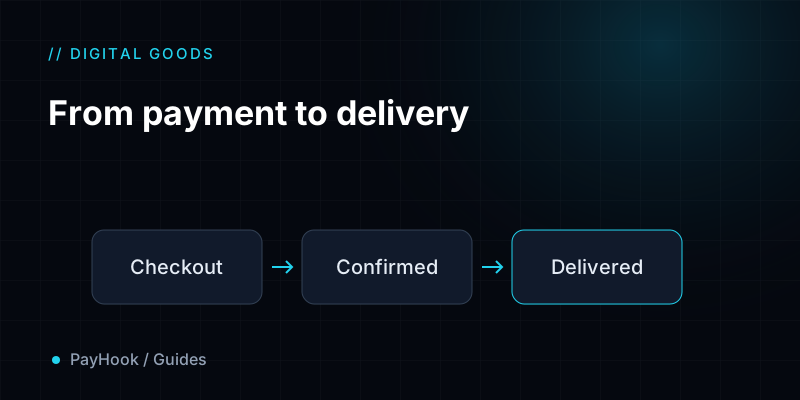
1. Customer selects crypto at checkout. Your backend calls POST /api/v1/payments/ with the amount, chain, and currency.
2. PayHook returns a checkout_url. Redirect the customer there. They see a hosted page with a QR code, deposit address, and countdown timer. Or use the response fields to build your own checkout UI.
3. Customer sends USDT from any wallet. PayHook watches the blockchain.
4. Payment confirms on-chain. PayHook POSTs a signed webhook to your server.
5. Your server verifies the HMAC signature, checks the external_order_id, and delivers the product.
curl -X POST https://api.payhook.app/api/v1/payments/ \
  -H "X-API-Key: pk_..." \
  -H "Content-Type: application/json" \
  -d '{
    "amount_usd_cents": 2900,
    "network": "bsc",
    "currency": "usdt",
    "external_order_id": "license-key-4f8a",
    "redirect_url": "https://yoursite.com/download/4f8a"
  }'
The entire integration (payment creation, webhook handler and signature verification) typically takes a developer about 30 minutes. The API documentation covers the full flow with examples in five languages.
Why non-custodial matters for digital goods
Many crypto payment processors are custodial: your customer's payment goes to the processor's wallet, and the processor settles to you later. For digital goods, this adds unnecessary risk and delay:
- Settlement delay. You've already delivered the product. Why wait for the processor's payout schedule to get the money?
- Counterparty risk. The processor holds your revenue. If they freeze your account or go down, you've delivered product without getting paid.
- KYC friction. Custodial processors typically require identity verification before you can withdraw. Non-custodial processors don't handle your funds, so there's nothing to withdraw.
With a non-custodial processor like PayHook, the crypto goes directly to your wallet. You have the funds the moment the customer pays. No middleman, no settlement, no withdrawal process.
Getting started
PayHook supports BSC, TRON and Ethereum with USDT on each chain. Every account gets 50 free payments every 30 days, enough to validate the channel before buying a pack. No KYC, no card required.
- Create an account and grab your API key
- Read the step-by-step integration tutorial
- See the full API documentation for request/response schemas and webhook verification
- Check pricing for pack prices
Related: Non-Custodial vs Custodial Crypto Payment Gateways · Crypto Payment Gateway Without KYC
Accept crypto for your digital products.
50 free payments every 30 days. No card, no KYC.