KYC (Know Your Customer) is a regulatory requirement for financial institutions. Banks, brokerages, and money transmitters must verify the identity of their clients. But when it comes to crypto payment processing, KYC requirements are often applied even when the underlying architecture doesn't require them.
For merchants who want to accept crypto payments, mandatory KYC creates friction, delays, and privacy concerns. Here's why a crypto payment gateway without KYC matters and when it's the right choice.
Why most crypto processors require KYC
Custodial payment processors, the ones that receive and hold your funds before settling to you, are classified as money service businesses in most jurisdictions. Because they handle your money, they're subject to AML (Anti-Money Laundering) regulations that require identity verification.
This means before you can accept your first payment, you typically need to:
- Submit government-issued ID and proof of address
- Wait for manual review (24 hours to several weeks)
- Provide business registration documents in some cases
- Pass ongoing monitoring checks that can freeze your account
For an established business with a legal entity, this is a speed bump. For a solo developer launching a side project, a freelancer in a country with limited documentation infrastructure, or a merchant who simply values privacy, it can be a hard stop.
Why non-custodial processors don't need KYC
The regulatory rationale for KYC is straightforward: if a business handles your money, it needs to know who you are. Non-custodial processors don't handle your money. The customer sends crypto directly to your wallet; the processor only watches the blockchain and notifies you.
Because no funds pass through the processor, the money-transmitter classification doesn't apply in the same way. The processor is providing a monitoring and notification service, not a financial custody service.
This distinction isn't a loophole. It's a fundamental architectural difference. The processor literally can't hold, freeze, or redirect your funds because it never has access to them.
What no-KYC means for merchants
Instant onboarding. Sign up with an email and password. Get an API key immediately. Start accepting payments the same day. No waiting for document review, no back-and-forth with a compliance team.
Global access. Merchants in countries where KYC documentation is difficult to obtain, whether because of infrastructure, bureaucracy or political instability, can still accept crypto payments. The barrier to entry is a wallet address and an API endpoint, not a government document.
Privacy. Your identity isn't stored on the processor's servers. In a world of regular data breaches at financial services companies, not having your ID documents in yet another third-party database is a tangible benefit.
No account freezes. Custodial processors can freeze your funds during a KYC re-review, a compliance flag, or a dispute. With a non-custodial processor, there's nothing to freeze. Your money is in your wallet, and the worst the processor can do is stop sending you notifications (at which point you switch to another processor).
When KYC is still appropriate
No-KYC isn't a universal answer. If you need fiat conversion (receiving crypto and having dollars land in your bank account), the entity handling that conversion will require KYC. That's a money transmission activity regardless of how the crypto side works.
If you're operating a regulated financial product yourself (a lending platform, an exchange, a custodial wallet), your own compliance obligations exist independently of your payment processor's requirements.
The no-KYC argument is specifically about the payment processing layer: should the tool that monitors the blockchain and sends you a webhook require your passport? For non-custodial architectures, the answer is no.
The practical difference
With a custodial processor: sign up, submit documents, wait for approval, fund an account, configure settings, then start accepting payments. Calendar time: days to weeks.
With a non-custodial, no-KYC processor: sign up, add wallet addresses, configure a webhook, call the API. Calendar time: 30 minutes.
For a merchant who already has crypto wallets and a server that can receive webhooks, the non-custodial path removes every barrier except the technical integration itself.
Getting started without KYC
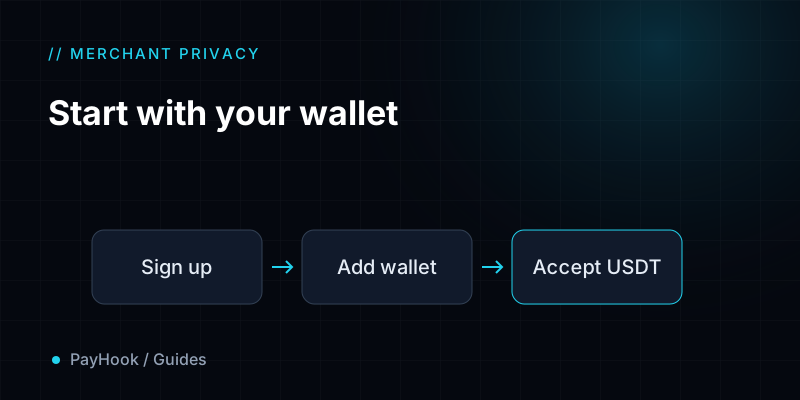
PayHook is a non-custodial crypto payment processor. No KYC, no card required. Sign up with an email, add your wallet addresses on BSC, TRON or Ethereum, and start accepting USDT payments through a REST API with HMAC-signed webhooks.
- Create an account; it takes 30 seconds
- Read the quickstart: four steps to your first payment
- 50 free payments every 30 days, then prepaid packs from 9 USDT (see pricing)
Related: Non-Custodial vs Custodial Crypto Payment Gateways · How to Accept Crypto Payments on Your Website
No KYC. No card. No waiting.
Sign up and accept your first crypto payment today.