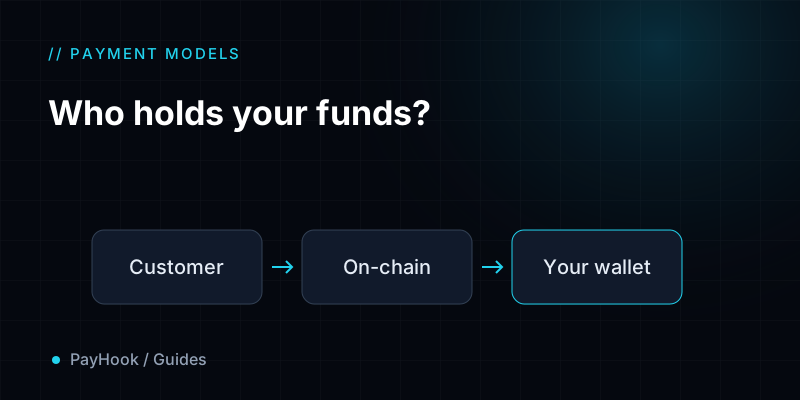
If you're evaluating crypto payment gateways, you'll run into two fundamentally different architectures: custodial gateways, which hold your funds, and non-custodial crypto payment gateways, which never touch them. Both let you accept crypto on your website, but they handle money in very different ways, and the trade-offs matter.
How custodial processors work
A custodial payment processor works like a traditional payment gateway adapted for crypto. When your customer makes a payment, the crypto goes to the processor's wallet, not yours. The processor holds the funds, confirms the transaction, and then settles to your payout address on their own schedule.
This model is familiar if you've used traditional payment processors. The processor takes a percentage cut (typically 0.5–1%), holds funds until its next payout, and usually requires identity verification before you can withdraw. The upside is simplicity: many custodial processors offer automatic fiat conversion, so you can receive crypto and get dollars in your bank account without managing wallets yourself.
The downside is counterparty risk. While the processor holds your funds, you're trusting that they won't get hacked, freeze your account, or become insolvent. The crypto industry has seen several high-profile custodial failures in recent years, and each one reinforced the same lesson: if someone else holds your money, they can lose it. For a worked example with real fees, see how a custodial gateway compares in NOWPayments alternative.
How non-custodial processors work
A non-custodial processor takes the opposite approach. Your customer sends crypto directly to a wallet address that you control. The processor never receives, holds, or has access to your funds. It just watches the blockchain.
Here's the flow: you register your wallet addresses with the processor. When a customer initiates a payment, the processor assigns one of your addresses as the deposit target. The customer sends crypto to your address from any wallet they choose. The processor monitors the blockchain, and once the transaction reaches enough confirmations, it sends a signed webhook notification to your server. You verify the signature and fulfill the order.
There's no settlement step because there's nothing to settle: the funds land in your wallet the moment the transaction confirms on-chain. No KYC is required because the processor never handles your money. Fees are typically flat per-payment rather than percentage-based.
Side-by-side comparison
| Factor | Custodial | Non-custodial |
|---|---|---|
| Fund flow | Through processor's wallet | Direct to your wallet |
| Settlement | On the processor’s payout schedule | Instant (on-chain confirmation) |
| Counterparty risk | Yes — processor holds funds | None — you hold funds |
| KYC required | Usually yes | No |
| Fee model | Percentage (0.5–1%) | Flat per-payment |
| Chargebacks | No (blockchain is final) | No (blockchain is final) |
| Fiat conversion | Often included | Not included (you receive crypto) |
| Setup complexity | Lower (hosted solution) | Slightly higher (API + webhook) |
When custodial makes sense
Custodial processors are a good fit when:
- You need automatic fiat conversion. If you want to receive crypto but need dollars or euros in your bank account, a custodial processor handles the exchange for you. This is useful for businesses that operate entirely in fiat and just want to offer crypto as a payment option.
- You don't want to manage wallet addresses. Custodial setups require less technical involvement. The processor handles address generation, key management, and blockchain monitoring behind a simple API or hosted checkout.
- You're comfortable with KYC and settlement delays. If your business already goes through identity verification for other payment processors, adding one more isn't a big deal.
When non-custodial makes sense
Non-custodial processors are a better fit when:
- You want to keep your crypto. If you plan to hold stablecoins like USDT rather than converting to fiat, there's no reason to route funds through a middleman. The crypto should land in your wallet directly.
- You want to eliminate counterparty risk. No processor can lose, freeze, or delay funds they never held. This is the strongest argument for non-custodial: your money is in your control from the moment the customer pays.
- You want instant access to funds. On-chain confirmation is usually under a minute on BSC. With a non-custodial processor, that's your settlement time, not the processor's payout schedule.
- You prefer flat fees over percentage-based pricing. On a $10,000 payment, a 1% fee costs $100. A flat per-payment fee (e.g. 0.002 USDT) costs the same regardless of amount.
- You operate in a jurisdiction where KYC adds friction. Non-custodial processors don't need to verify your identity because they don't handle your funds. No forms, no ID uploads, no waiting for approval.
- You already have crypto wallets. If you're already in the crypto ecosystem, non-custodial is the natural fit. You provide the addresses, the processor watches the chain.
Choosing between them
Both models work. Custodial is simpler if you need fiat conversion and don't mind the trade-offs. Non-custodial gives you more control, lower risk, and faster access to your funds.
The right choice depends on one question: do you want to hold crypto, or convert it? If you want to hold it, non-custodial removes the middleman entirely. If you need fiat, custodial handles the conversion for you.
For merchants who are already comfortable with crypto wallets and want payments to land directly in their control, non-custodial is the straightforward choice. You get the payment infrastructure (API, webhooks, dashboard, hosted checkout) without giving up custody of your money.
Related: Crypto Payment Gateway Without KYC · Accept USDT Payments in 30 Minutes
Try non-custodial payments.
50 free payments every 30 days. No card, no KYC.